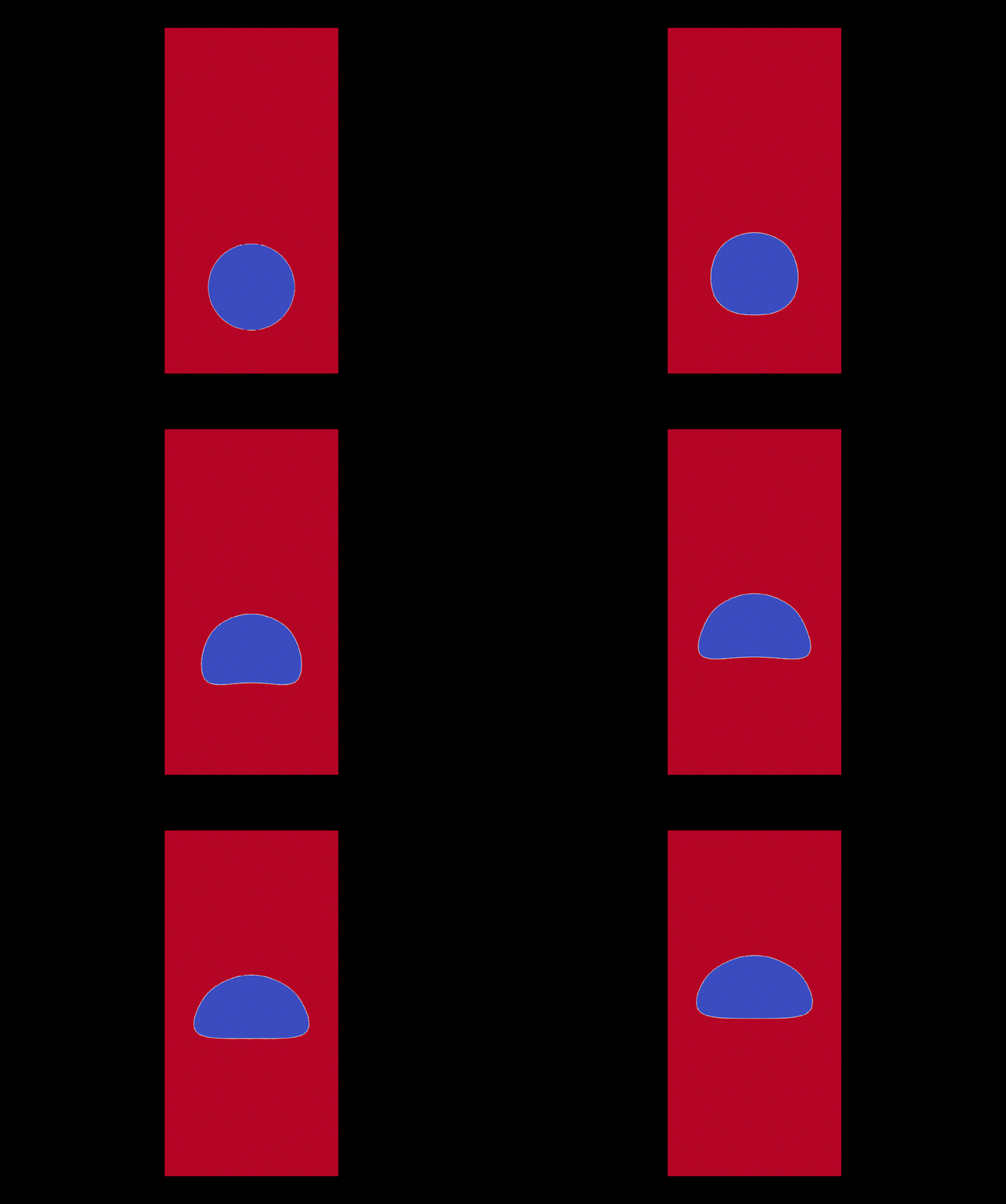
Description
This case presents a two-dimensional multiphase simulation of a rising bubble.
Reference paper: Quantitative Benchmark Computations of Two-Dimensional Bubble Dynamics
Model
The model geometry was created using blockMesh in OpenFOAM. The geometry is a cuboid with the front and back faces defined as empty patches for the two-dimensional simulation.
The domain has the following dimensions:
- Width: $1 \mathrm{m}$
- Height: $2 \mathrm{m}$
- Depth: $0.2 \mathrm{m}$
The bubble was initialized at the position
$$ (x,y,z)=(0.5,0.5,0) $$
with a radius of
$$ r=0.25\,\mathrm{m} $$
Meshing
The mesh was generated using the blockMesh utility in OpenFOAM.
The resulting mesh contained:
- 320,000 hexahedral cells
- 642,402 points
The front and back faces of the domain were assigned the empty boundary condition to represent a two-dimensional simulation.
Physics
The incompressible volume-of-fluid method was used to model the free surface between the bubble and the surrounding liquid. This method is useful when tracking the interface between two phases.
The continuity equation is
$$ \frac{\partial u}{\partial x} + \frac{\partial v}{\partial y} + \frac{\partial w}{\partial z} =0 $$
The momentum conservation equations are
$$ \frac{\partial u}{\partial t} + u\frac{\partial u}{\partial x} + v\frac{\partial u}{\partial y} = -\frac{1}{\rho_{\mathrm{mix}}} \frac{\partial P}{\partial x} + \frac{\mu_{\mathrm{mix}}}{\rho_{\mathrm{mix}}} \left( \frac{\partial^2 u}{\partial x^2} + \frac{\partial^2 u}{\partial y^2} \right) + g_x + F_{s,x} $$
$$ \frac{\partial v}{\partial t} + u\frac{\partial v}{\partial x} + v\frac{\partial v}{\partial y} = -\frac{1}{\rho_{\mathrm{mix}}} \frac{\partial P}{\partial y} + \frac{\mu_{\mathrm{mix}}}{\rho_{\mathrm{mix}}} \left( \frac{\partial^2 v}{\partial x^2} + \frac{\partial^2 v}{\partial y^2} \right) + g_y + F_{s,y} $$
The mixture density is calculated as
$$ \rho_{\mathrm{mix}} = \alpha\rho_{\mathrm{liq}} + (1-\alpha)\rho_{\mathrm{gas}} $$
The mixture viscosity is calculated as
$$ \mu_{\mathrm{mix}} = \alpha\mu_{\mathrm{liq}} + (1-\alpha)\mu_{\mathrm{gas}} $$
Here, $\alpha$ is the volume fraction. The surface tension force is given by
$$ \mathbf{F}_s = \sigma\kappa\nabla\alpha $$
where the interface curvature is
$$ \kappa = \nabla\cdot \left( \frac{\nabla\alpha}{|\nabla\alpha|} \right) $$
Simulation
The case was simulated using the incompressibleVoF solver in OpenFOAM.
The volume fraction of the liquid phase, $\alpha$, was initialized to zero inside the bubble and to one elsewhere.
The default value of alpha.water was set to one throughout the domain. The setFields utility was then used to set the value of alpha.water to zero inside a cylindrical region defined by:
- p1 = (0.5 0.5 -0.2)
- p2 = (0.5 0.5 0.2)
- radius = 0.25
Fluid Properties
| Property | Value |
|---|---|
| $\nu_{\mathrm{liq}}$ | 0.01 |
| $\nu_{\mathrm{gas}}$ | 0.01 |
| $\rho_{\mathrm{liq}}$ | 1000 |
| $\rho_{\mathrm{gas}}$ | 100 |
| Surface tension coefficient, $\sigma$ | 24.5 |
| Gravitational acceleration, $g_y$ | 0.98 |
These properties result in a Reynolds number of
$$ Re=35 $$
and an Eötvös number of
$$ Eo=10 $$
Boundary Conditions
| Parameter | internalField |
leftRight |
bottomTop |
frontBack |
|---|---|---|---|---|
alpha.water |
Initialized using setFields |
zeroGradient |
zeroGradient |
empty |
| Velocity | uniform (0 0 0) |
slip |
noSlip |
empty |
Pressure (p_rgh) |
uniform 0 |
fixedFluxPressure |
fixedFluxPressure |
empty |
The transient laminar flow simulation was run for a total time of $3\,\mathrm{s}$, using a time step of
$$ \Delta t=10^{-5}\,\mathrm{s} $$
The solution was obtained using the Pressure-Implicit with Splitting of Operators (PISO) algorithm with:
- 3 correctors
- 1 outer corrector
- A relaxation factor of 0.3 for
p_rgh
Validation
The results were validated using the available bubble validation dataset.
The dataset c1g1l7 was used for the validation.
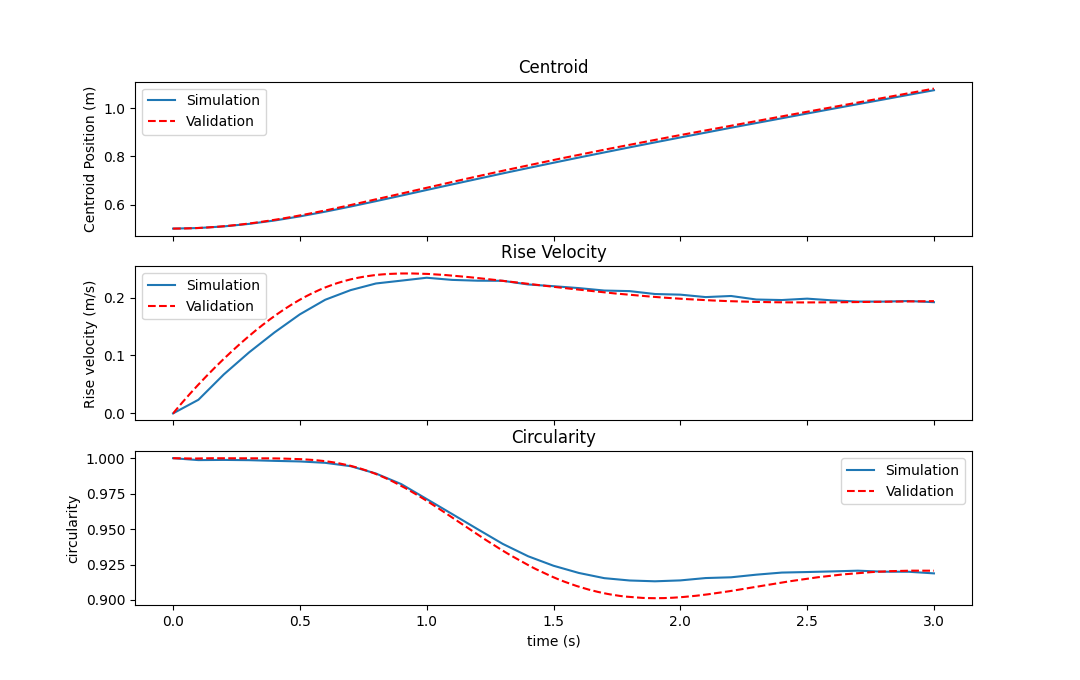
The following quantities were compared with the validation data:
- Bubble centroid
- Bubble rise velocity
- Bubble circularity
The simulation results are in close agreement with the validation results.